Panic at Night? What to Do When Everything Feels Too Loud
When panic hits at night, the goal is not to fix your whole life. It is to get through this hour without escalating the spiral.
The first time it happened, Lina was not even asleep yet.
She was lying in bed, scrolling through nothing in particular, when her chest suddenly tightened.
Her heart started pounding so hard she could feel it in her throat. Her hands went cold. Her thoughts snapped from ordinary worries like "Did I send that email?" to "I think I am dying."
She sat up and tried to gasp for air. The room looked strange around the edges. For a moment, she considered calling an ambulance, because how could something this physical be "just anxiety"?
Twenty minutes later, the symptoms faded.
The room was the same.
Her life was the same.
But nights changed for her. Night became the place where this could happen again.
If you are reading this because your nights feel like that, heart racing, chest tight, thoughts on fast-forward, you are not alone. Cleveland Clinic describes nocturnal panic attacks as sudden night panic with physical symptoms such as racing heart, sweating, and difficulty breathing. The NHS also notes that panic attacks can feel frightening and physical, even though many attacks pass within minutes.
Short answer: when panic hits at night or your mind is racing and you cannot sleep, start by checking immediate safety, slowing your breathing, grounding yourself in the room, and deciding whether this is a moment you can ride out with coping tools or a moment to reach for real-time support.
Tonight, the goal is not to fix your whole life.
It is to get through this hour without escalating the spiral.
If you feel like you cannot get through tonight
Some nights are not just hard.
They feel like a line you are not sure you can cross.
If you feel like you might harm yourself, cannot stay safe tonight, or are thinking about ending your life, this is not a moment to stay alone with a blog post. It is a moment to reach for immediate help.
In Australia, these services are available:
- Lifeline: 24/7 crisis support and suicide prevention. Call 13 11 14, text 0477 13 11 14, or visit lifeline.org.au.
- Beyond Blue: support for anxiety, depression, and suicidal thoughts. Call 1300 22 4636 or visit beyondblue.org.au.
- Suicide Call Back Service: 24/7 phone and online counselling. Call 1300 659 467.
- Emergency services: if you or someone else is in immediate danger, call 000 in Australia.
- United States: call or text 988 for the Suicide and Crisis Lifeline.
These services exist for nights like this. You do not have to justify how "bad" it is to deserve support. If you are not sure whether to call, that is already a sign you may benefit from talking to someone right now.
This page offers reflective, practical support for difficult nights. It is not medical care or crisis intervention. If at any point you start to feel unsafe, stop reading and contact one of the services above or the relevant helpline in your country.
What to do in the next five minutes
If you are not in immediate danger but feel close to panicking, overwhelmed, or trapped in racing thoughts, shrink the task.
Do not solve the whole night.
Work with the next five minutes.
The NHS recommends staying where you are if possible during a panic attack, breathing slowly and deeply, reminding yourself that the attack will pass, and focusing on something peaceful or grounding. Lifeline also frames panic support around learning tools, support, and professional help when needed.
1. Stay where you are, if you can
If you feel a panic attack coming on, stay where you are if it is safe.
You do not have to pace, flee, or make a major decision. Sitting up in bed or moving to a chair in the same room can be enough.
Look around and quietly name:
- the room you are in
- the year and day if you know them
- one thing that suggests you are currently safe
- one object that has not changed
Example:
I am in my bedroom.
It is night.
The door is locked.
The lamp is beside me.
This is panic. I do not need to solve everything right now.
If you have chest pain with other warning signs, are worried this could be a medical emergency, or the sensations are new and alarming, trust that concern and contact a health helpline or emergency services.
If the sensations are intense but familiar and you have been told they are panic attacks, move to breathing and grounding.
2. Breathe on purpose, not on panic
During panic, breathing often becomes shallow and fast. That can make the body feel even more threatened.
Try this for a few rounds:
Inhale gently through your nose for 4.
Exhale slowly through your mouth for 6.
Repeat.
You are not trying to erase the feeling instantly.
You are giving your nervous system a different rhythm to follow.
If counting makes you more anxious, drop the numbers. Just breathe in slowly and breathe out more slowly.
3. Ground yourself in the room
When panic takes over, attention collapses into worst-case thoughts and body sensations.
Grounding shifts part of your attention back to the world around you.
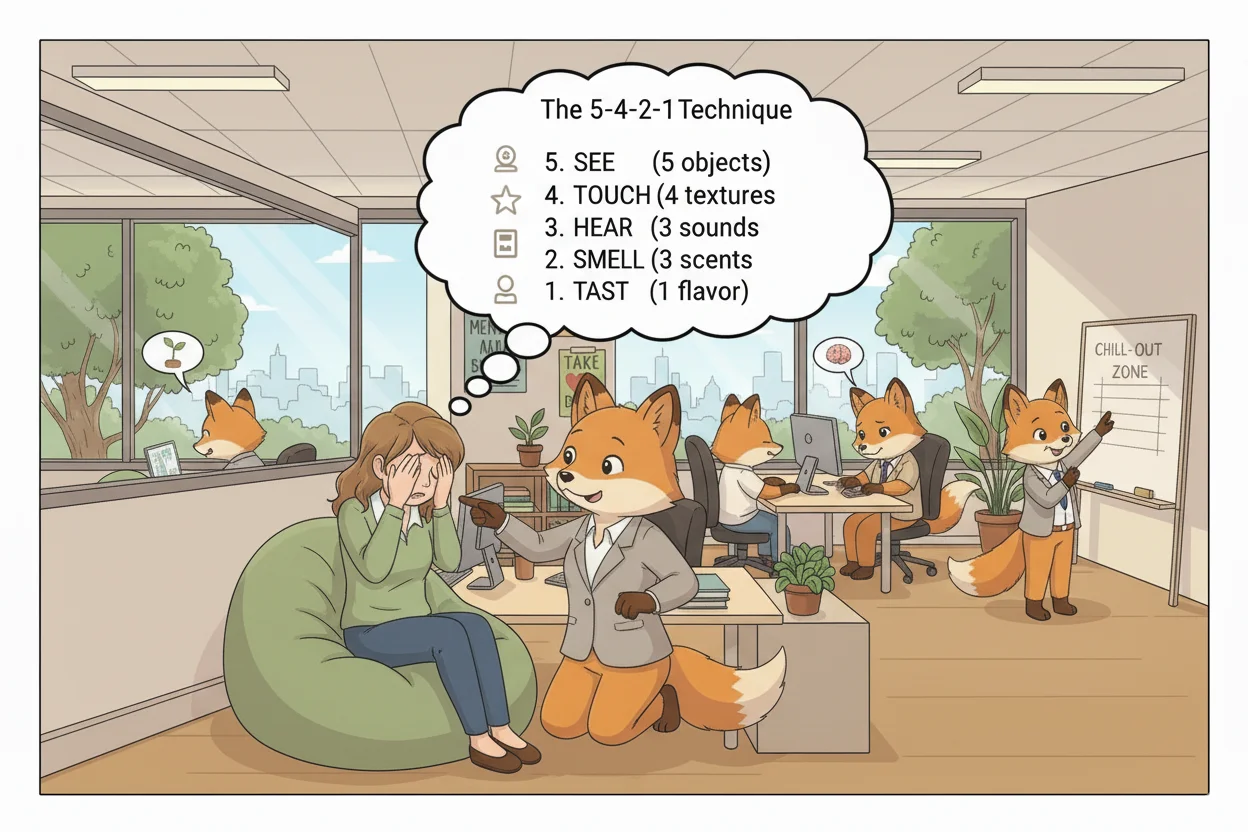
Try the 5-4-3-2-1 method:
- 5 things you can see
- 4 things you can touch
- 3 things you can hear
- 2 things you can smell
- 1 thing you can taste
Speak them out loud if you can.
The point is not to do it perfectly. The point is to give your mind something neutral and concrete to hold.
4. If your mind is racing and you cannot sleep
If the main problem is not panic but thoughts that will not stop, forcing sleep often backfires.
Sleep Foundation notes that nighttime anxiety can include racing thoughts and physical symptoms, and that breathing, writing, exercise, and professional support can all matter depending on the pattern.
For tonight, try this:
1. Sit up or move to a chair in the same room.
2. Write the repeating thoughts as bullet points.
3. Add: "These are on paper. I can return to them tomorrow."
4. Do 3 rounds of slow breathing.
5. Return to bed when your body feels slightly more settled.
You are not dismissing the worries.
You are refusing to let 3 AM become an emergency meeting about your entire future.
5. If reading steps is too much
Some nights, even reading instructions is too much.
Your eyes skim the words, but your body is still tight. Your mind keeps sliding away. You need structure, but you cannot hold structure.
That is what the Night Reset Script is for.
It is not a cure. It is a guided path for the exact kind of hour when you would rather be led than read.
Open Breathe Again and use the Night Reset Script when you need one small instruction at a time.
If you think you are having a panic attack at night
Nocturnal panic attacks can wake you from sleep or hit just as you are drifting off.
They can include:
- intense fear
- racing heart
- breathlessness
- chest discomfort
- sweating
- trembling
- dizziness
- fear that something terrible is happening
Many people initially mistake them for a physical emergency. That is understandable. The sensations are not imaginary.
Cleveland Clinic describes nocturnal panic attacks as real physical events that can feel like choking, a racing heart, sweating, and terror. The NHS also notes that panic attacks can include chest pain, shortness of breath, trembling, chills, and fear of dying.
If you suspect this is panic and not a medical emergency, try:
- stay where you are, if safe
- breathe slowly and deeply
- remind yourself that the attack will pass
- focus on one neutral object or sensation
- keep your body supported rather than fighting every sensation
Over the next few days or weeks, if episodes repeat, it is worth talking to a GP or mental health professional. Panic attacks can be treated, and you do not need to keep guessing alone.
If you cannot sleep because your mind will not stop
Not every hard night is a panic attack.
Sometimes the struggle is quieter but just as exhausting. You lie in bed and your mind starts cycling through deadlines, money, health fears, conversations, relationship pain, and every unfinished task.
The mistake is trying to win the argument with every thought.
At night, your brain is not always asking for a solution. Sometimes it is asking for containment.
Try a "parking page":
Things my mind is trying to solve tonight:
-
-
-

What can wait until daylight:
-
-

One thing I can do now:
-
Then close the page.
You are not abandoning the problems. You are putting them somewhere your mind does not have to keep rehearsing them.
If your anxiety always shows up at 3 AM
Some people notice a pattern: waking around the same time with dread, or finding that 3 AM is when everything feels louder.
Night anxiety can be affected by stress, sleep disruption, trauma, insomnia, caffeine, substances, and unprocessed daytime worry. Sleep Foundation notes that persistent nighttime anxiety is worth discussing with a doctor or mental health professional, especially when it affects sleep and daytime functioning.
Longer-term relief often needs daytime support too:
- reduce late caffeine or alcohol if they worsen nights
- build a consistent wind-down routine
- write worries earlier in the evening
- make a small plan for the next day before bed
- seek therapy or medical support if anxiety is frequent or intense
For tonight, keep it simpler:
This is a night wave.
I do not need to analyse my life in the dark.
I can protect the next hour and revisit the bigger questions in daylight.
If you just need to calm down fast
There are nights when theory feels far away.
You do not want an explanation.
You want the intensity to come down enough that you can think.
Try one of these:
- slow breathing: in 4, out 6
- progressive release: tense and release your feet, legs, hands, shoulders, jaw
- cold water: hold a cool glass or splash your face if safe
- one object: describe a neutral object in detail for one minute
- one person: text someone safe, "I am having a hard night. Can you stay with me for a few minutes?"
Choose one.
Do it badly if you have to.
Doing one grounding action imperfectly is better than reading ten techniques while the spiral keeps rising.
Let the Night Reset Script hold the hour
On some nights, you can read, think, and choose.
On other nights, your body is tired and your mind is scattered. You need the structure held for you.
The Night Reset Script was built for that second kind of night.
It gives the hour a shape:
First: reduce the body alarm.
Then: put the racing thoughts somewhere outside your head.
Then: choose one safer next step.
Then: leave yourself a script for the next hard night.
The point is not to win the night.
The point is to protect tomorrow by getting through this one hour as gently as you can.
Open Breathe Again when you would rather be guided than read.
Build your Night Reset Script
If you want to make your own version now, use this:
When panic starts, I will first:

The breathing pattern that works best for me:

The grounding exercise I can remember at night:

The person or service I can contact if I feel unsafe:

The thought I need to postpone until daylight:

One sentence I want future me to read:
Example:
When panic starts, I will first: sit up and put both feet on the floor.
The breathing pattern that works best for me: in 4, out 6.
The grounding exercise I can remember at night: 5 things I can see.
The person or service I can contact if I feel unsafe: Lifeline 13 11 14 or Maya.
The thought I need to postpone until daylight: whether everything is falling apart.
One sentence I want future me to read: This has happened before and it passed.
That is the artifact.
Not a perfect solution.
A reusable path through a hard hour.
Further reading
- Cleveland Clinic on nocturnal panic attacks
- NHS on panic disorder and panic attacks
- Sleep Foundation on anxiety at night
- Lifeline Australia on panic attacks
If you might hurt yourself or someone else tonight, stop here and contact real-time support now: Lifeline 13 11 14 in Australia, Beyond Blue 1300 22 4636, 988 in the United States, or local emergency services.
Turn this reading into Night Reset Script.
If this article is close to what is happening, start from the situation page. It gives one small win first, then routes into Breathe Again.
Start with: I can't sleep tonight