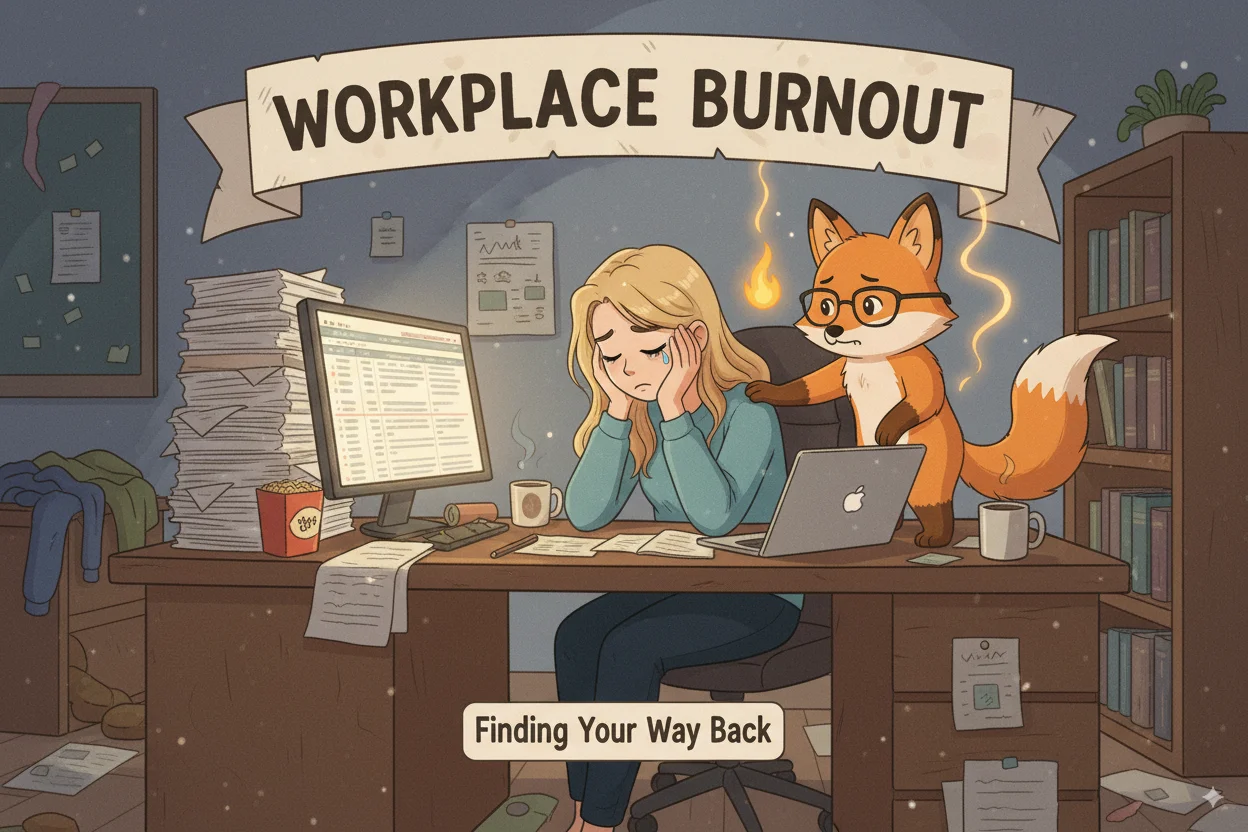
Why the Most Responsible Person on the Team Burns Out First
The person who responds to every message, covers every gap, and still believes one more effort will fix the broken system. Research shows they don't burn out slower—they burn out faster. Here's the psychology behind why.
settles in quietly beside you 🦊
I want to talk about someone specific.
The person who replies to every message. Who starts preparing for QBR three days early. Who gets passed between teams like a problem no one wants to own—and still quietly picks everything up and makes sure it doesn't drop.
The person who genuinely believes: if I just try a little harder, if I'm just a little more responsible, this broken system will turn around.
In my work supporting people through workplace burnout, I see this person constantly. And here's what the research—and my experience—keeps confirming:
They don't burn out slower than everyone else. They burn out faster.
This is why.
The Trap of Learned Helplessness
When clients come to see me after years in toxic workplaces, they describe something that feels like a character flaw but is actually a neurological adaptation.
They say: "I know I could do this work. I've done it before. But I just can't make myself care enough to start."
What they're describing has a name in psychology: learned helplessness.
The concept comes from research showing that when a living being exerts effort repeatedly in an environment where that effort doesn't reliably change outcomes, the brain makes an unconscious calculation: effort is pointless.
Once that belief is encoded into the cognitive system, it doesn't stay contained to the original environment. It starts seeping into everything—including the areas where effort would actually make a difference.
High-responsibility people are disproportionately vulnerable to this, for a cruel reason: they try harder, longer, and with more genuine investment than most. Which means they have more data points confirming that their efforts don't change anything. The lesson gets learned faster.
When Work Becomes Meaningless (But You Still Have to Excel at It)
Anthropologist David Graeber coined the term "bullshit jobs"—roles where even the people doing them privately doubt whether the work has any genuine value.
Many toxic workplaces have evolved into elaborate ecosystems of this. Analysts build models. Consultants build frameworks. Middle managers manage the process of consulting the analysts who built the models. Months later, the output might be a conclusion that anyone with common sense could have reached in an afternoon.
Everyone in that chain knows, on some level, what's happening. But everyone needs the system to keep running—because mortgages, visas, and career trajectories are tied to it.
Here's the thing: the workload itself isn't what destroys people in these environments.
It's the cognitive dissonance.
The experience of knowing, in your gut, that something is wrong—while still being required to perform complete commitment to it. Two contradictory forces running simultaneously, burning energy constantly, eroding something much harder to rebuild than physical stamina.
The McKinsey Health Institute studied burnout across 15 countries and found that of all the contributing factors, toxic workplace behaviour was the strongest predictor—not workload, not hours, not role ambiguity. Employees in highly toxic environments were nearly 8 times more likely to experience burnout symptoms than those in healthy ones.
And within those environments, the high-adaptability, high-responsibility people? They didn't have a protective advantage. They had a liability. Because they kept going longer before breaking.
What Actually Gets Depleted (It's Not Willpower)
When I work with people navigating this, I find it's important to name precisely what's being lost—because most of us have been taught to think about the wrong resource.
This isn't a willpower problem. It's not an emotional regulation problem. It's not a resilience problem.
What burns out is something I think of as 心力 (xīn lì)—roughly translated as "heart energy," or the internal capacity to act from a place of groundedness and self-direction.
In a healthy environment, this is a renewable resource. You invest energy, you receive feedback—recognition, growth, a sense of meaningful contribution—and that feedback replenishes what you spent. A loop.
Toxic environments break the loop.
You keep investing. But what comes back is distorted: your judgment is questioned, your effort is discounted or attributed elsewhere, your boundaries are treated as inconveniences. The evaluation system doesn't reflect what you actually did—it reflects your proximity to whoever holds power.
There's no replenishment. Just output. The tank drains, slowly and invisibly, until one day it's empty—and you're staring at a task that should be simple, that you've done a hundred times, and you genuinely cannot bring yourself to start it.
Chronic stress keeps cortisol elevated. Over time, the prefrontal cortex—the part responsible for decision-making, emotional regulation, and long-term perspective—becomes suppressed. The capacities that made you "good at your job" literally start to deteriorate at a biological level.
How a Toxic Environment Rewrites Your Inner Map
Swiss psychologist Jean Piaget described how humans use schemas—internal frameworks—to make sense of the world and respond to it.
When you spend a long time in an environment where the rules are distorted, those schemas start to get rewritten. Gradually, without your awareness.
You start normalising the abnormal. Accepting violations as part of the deal. Interpreting your own exhaustion as personal weakness rather than a rational response to an irrational system.
The internal recalibration happens silently. You don't notice your reference points shifting.
Until one day you catch yourself waiting—after sending a report, before you've even had a chance to assess your own work—just waiting. For a Slack reaction. For a response. Wondering whether what you did had value based entirely on whether someone else acknowledges it.
And you vaguely know this reaction isn't quite right. You just don't remember when it started.
The Recognition Machine (And Why It's Designed This Way)
For people in large organisations—particularly in tech—there's an additional layer worth understanding.
These environments are, structurally, recognition-production machines.
They come with precisely defined feedback points: performance reviews, promotion panels, OKR completion rates, calibration outcomes, 360-degree feedback cycles. Each one is a scheduled moment where you receive an external verdict on your worth.
Over time, this trains your nervous system to do one specific thing: link external feedback with your sense of self-value.
The binding runs deep. You start using your performance rating to evaluate how the past six months felt. You use whether you got promoted to measure whether your effort was adequate. You use your manager's tone in a one-on-one to calibrate whether this week's work was on track.
Here's what makes this particularly entangling: the recognition doesn't come on a predictable schedule. Sometimes it's there; often it isn't. Feedback is sporadic, contingent on factors outside your control.
Behavioural psychology has a name for this: variable ratio reinforcement. B.F. Skinner demonstrated in the 1950s that when rewards appear unpredictably—sometimes present, sometimes absent—the behaviour becomes more entrenched than with consistent rewards, and much harder to disengage from.
It's the mechanism behind gambling. You don't know if this pull of the lever will pay out—which is exactly why you pull it again.
A recognition system that sometimes rewards you, sometimes doesn't, unpredictably and based on factors you can't fully control, produces the same psychological dynamic. More sensitivity to signals. More craving when they don't come. More investment in the hope that the next one will land.
Every time you hand over the authority to evaluate your own worth, your internal stability gets a little shakier.
The Professional Mask Problem
Carl Jung introduced the concept of the Persona—the external identity we develop to meet the demands of our social environment.
The professional mask in a high-performance workplace looks something like: always able to deliver. Ownership over everything. Data-driven. Articulate in communications. Always on. Doesn't let emotions affect the work.
This mask isn't wrong. It's adaptive. It helps you function.
The problem Jung identified is what happens when you over-identify with it—when you start to believe the mask is the real you. When anything that threatens the mask (a critical review, a missed promotion, a moment of visible struggle) feels like a threat to your fundamental self.
In high-pressure organisations, this identification gets particularly deep, because the mask is continually rewarded and reinforced. You're recognised precisely for performing it well. Of course you start to believe it.
Until the day the system stops rewarding the performance. Or the performance becomes unsustainable. And you don't know who you are underneath.
Three Ways Back
Recovery from this kind of burnout isn't linear, and it doesn't happen quickly. But there are specific places to start.
1. Identify the Limiting Belief
It won't announce itself directly. It shows up in reactions.
Unease when feedback doesn't arrive. Your whole state collapsing after a calibration result. Monitoring your manager's expression during a one-on-one for signs of approval.
These reactions have the same belief running underneath: my value = being recognised.
The first step is just to see it clearly. Not to fix it immediately—just to name it. "Oh. That's the belief that's been driving this."
2. Reclassify Recognition as Information, Not Energy
External recognition isn't harmful in itself. The problem is the role you've assigned it.
When your manager gives you feedback, when a promotion decision comes through, when a project gets acknowledged—these are information. Useful data points about how your work landed, what to adjust, where you stand within a particular system.
They are not the source of your energy. They are not the verdict on your worth as a person.
This reclassification is gradual work. But it changes the stakes dramatically. Information can be assessed, acted on, filed away. Energy sources you become dependent on.
3. Reconnect with Your Internal Sensing System
Before checking anyone else's reaction to what you just did—take two seconds. Ask yourself: What do I think about this? How do I feel about how that went?
That inner signal still exists. It's been drowned out by years of external feedback loops. But it's there.
Rebuilding access to it is how heart energy eventually becomes renewable again—not because you stop caring what others think, but because when no external recognition arrives, you don't lose your footing completely.
Amy's Story
A year ago, Amy left a large tech company after three years.
She'd spent the final stretch embedded in workplace politics she hadn't chosen: helping a manager who was rushing to expand his scope, writing documents and building demos to impress leaders two levels up, attending meeting after meeting, translating two engineers' worth of actual work into twelve engineers' worth of perceived impact.
The output metrics looked fine. But inside, Amy knew what the work actually was—and wasn't. The cognitive dissonance had been running for months.
She wasn't managing someone else's team in the way she wanted to grow. She wasn't building things she believed in. She was maintaining a system of polished appearances, using her genuine skills to prop up something hollow.
When she left, she didn't feel liberated.
She felt nothing.
The rest of Amy's story—what happened in the weeks after she left, and how she eventually found her way back—is in Part 2.
settles beside you gently
If you recognised yourself anywhere in this—the automatic responsiveness, the belief that one more effort will fix it, the quiet erosion of your own internal compass—I want you to know something:
This is not a personal failing.
This is what happens when a particular kind of person—conscientious, capable, genuinely invested—spends long enough in a particular kind of environment.
The capacity to care deeply is not the problem. It's one of your most important qualities.
The system just learned how to use it against you.
🦊 At sisithefox.com, I work with people navigating burnout from high-pressure environments. You don't have to figure this out alone.
Turn this reading into Stay / Shift / Leave Brief.
If this article is close to what is happening, start from the situation page. It gives one small win first, then routes into Work Crossroads.
Start with: Should I quit my job