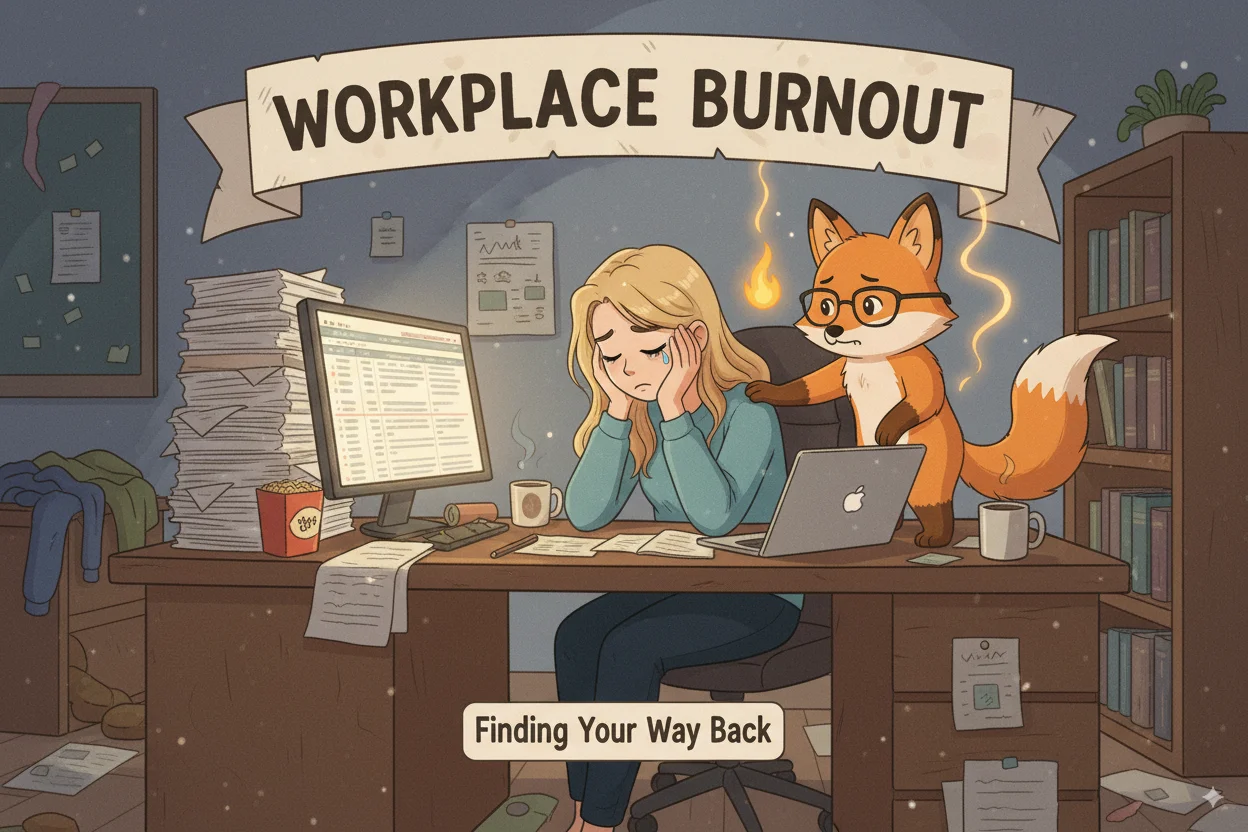
How I Discovered I Was Burnt Out: A Real Story (Not a Checklist)
I didn't know I was burning out—I just knew something was wrong. This is the real story of how burnout actually feels from the inside, and the specific things that helped (and didn't).
curls up beside you, speaking quietly 🦊
I want to tell you something I don't usually lead with in my more polished posts.
A while back, I was burnt out. Not the aesthetic kind where you post a "taking a digital detox 🌿" story. The real kind—where you're dragging yourself through each day and don't even have the vocabulary to name what's happening.
The actual burnout had probably started before I noticed it. By the time I clocked it, I'd been running on empty for weeks. And the strangest part? I didn't know I was burnt out. I just knew something was wrong.
This is that story—how I noticed, what it actually felt like, and what helped me come back.
Part One: Something Was Off
I didn't start by researching burnout. I started by noticing that my "normal" was starting to feel really, really not normal.
Here's what I noticed first:
The Sunday–Friday Cycle From Hell
Sunday afternoons were the worst. Around 4pm, a low-level dread would start creeping in. My mind would start running through everything I had to do on Monday—before Monday had even started. By Sunday evening, I was already exhausted by a workday that hadn't happened yet.
The whole week, I'd be counting down to Friday. Not in a lighthearted "TGIF" way. In a desperate, survival-mode way—like Friday was a life raft.
And then Friday night would come, and I'd feel this enormous, almost physical release. Like I'd been holding my breath for five days. The whole weekend until Sunday morning felt like I could finally exist again.
That cycle—Sunday dread, Friday relief—was my first clue that something was seriously out of balance.
The Exhausted-But-Wired Loop
After work, I was completely depleted. Like, can't-form-sentences depleted. Even if I had tasks I genuinely needed to finish, I couldn't bring myself to start.
But then—and this is the cruel part—when it actually got close to bedtime, the anxiety would kick in. You haven't done that thing. You need to do that thing. So I'd force myself to sit down and start working, then fall into a rabbit hole until midnight or 1am, wondering why I couldn't sleep.
The sleep problems followed. Lying awake longer than I used to. Taking forever to fall asleep. Waking up still tired.
It became this loop: exhausted → can't work → anxious at bedtime → force myself to work late → can't sleep → wake up exhausted → repeat.
I Was Talking About Work. Constantly.
I started noticing that about 70–90% of my conversations with friends and family were me complaining about work.
Not venting occasionally. Constantly. In every catch-up, every lunch, every text exchange.
That's when it hit me: I wasn't just venting. My brain was obsessing. Even when I wasn't at work, I was mentally still there. Running over problems, replaying difficult interactions, pre-worrying about tomorrow.
My mind had forgotten how to fully leave.
My Brain Stopped Working the Way It Used To
This one scared me.
I'd walk over to tell a colleague something, and by the time I reached their desk—maybe two minutes later—I'd completely forgotten what I was going to say. Not a vague "on the tip of my tongue" moment. Gone. Like the thought had never existed.
Explaining things started taking longer. I'd be trying to describe a problem I was working on, and the words wouldn't come the way they used to. I'd stumble, circle back, lose my train of thought mid-sentence.
Focus Became Fragile
Deep work, which used to be my superpower, started feeling almost impossible.
Getting into a focused state took so much longer than before. And once I was there, the tiniest thing could knock me out of it—a message notification, someone stopping by my desk, a quick question from a colleague. Then I'd need ages to find my way back.
I'd lost my ability to multitask, too. I used to be able to juggle several things at once—knowing the order, tracking progress, switching fluidly. Now, I had to check my to-do list constantly just to remember what I was supposed to be doing next. Like my RAM had been cut in half.
Part Two: Naming It
After noticing all of this, I was confused and a bit scared. I didn't know what was happening—I just knew I wanted to get back to normal, especially the sleep.
It was actually by chance that I started reading about burnout online. I came across some posts from other people describing their experiences, checked the symptoms, and felt that uncomfortable recognition: oh. This is what I have.
I'd never really understood burnout as a concept before. I thought it was just being "really, really tired." But reading those accounts helped me realise it was something specific—a state my nervous system had fallen into after chronic, unmanaged stress.
And somehow, just having a name for it helped. It wasn't some mysterious personal failing. It was a thing that happened. And it was something that could change.
Part Three: What Actually Helped
After reading a lot of advice, I tried different things. Some worked. Some didn't. Here's my honest breakdown.
At Work
Reminding myself the work wasn't that important.
This sounds almost too simple, but it was genuinely powerful. I had to consciously interrupt the part of my brain that treated every task as urgent and critical. Most things weren't. I started asking myself: "If this doesn't get done today, will it matter in a month?" The answer was almost always no.
Stopping before I was stuck.
I used to push through problems—putting my head down, grinding away, not wanting to ask for help. During burnout, I changed my approach: if I couldn't figure something out within a reasonable timeframe, I'd just ask. It felt almost embarrassing at first. But it actually got things resolved faster, and I wasn't burning myself out trying to solo-solve everything.
Protecting focus time properly.
When I really needed to concentrate, I'd go find an empty meeting room, set a timer, and work without any interruptions. Not just "I'll try not to get distracted." Actually removing myself from the environment where distractions happen.
In Life
Melatonin for the sleep issue.
Honestly, I tried a lot of things for the sleep problems and nothing clicked. Eventually I tried melatonin—taking one when I couldn't fall asleep. It helped. I'm not saying it's a solution for everyone, but for me, having something practical to lean on when the sleeplessness hit made a real difference.
Exercise that demands full attention.
I tried going for walks to "clear my head." It didn't work—I just walked and thought about work the entire time.
What did work: tennis. Boxing classes. Activities that are cognitively demanding enough that you genuinely cannot think about anything else. When you're trying not to get hit or figuring out where to aim, work doesn't get a seat at the table.
Replacing doomscrolling with long-form reading.
When I was anxious and dreading the next workday, my instinct was to reach for my phone. But I noticed the scrolling made everything worse—I'd end up with that horrible feeling of "I want to do so many things and have energy for none of them."
So I tried swapping phone time for actual books. Long ones. The kind that absorb you slowly. It wasn't a perfect fix, but it settled my brain in a way that the phone never could.
What Didn't Help (Honest Edition)
I also tried things that the internet recommended which just... didn't work for me.
Trying to find "meaningful" hobbies outside work.
The theory is solid: find something that gives you a sense of accomplishment that isn't your job. The problem? During burnout, I had basically zero motivation or energy. I'd plan to start things, but rarely did. And the planning itself sometimes made things worse—I'd end up in a new multi-tasking spiral just thinking about all the things I should be doing.
Going for walks.
For me, walking just meant my body was moving while my brain stayed stuck in work mode. It might work beautifully for other people—everyone's nervous system is different. But I needed something that forced me to be truly present. Walks weren't enough.
Coming Back
Recovery wasn't dramatic. It didn't happen on a specific day.
It was more like... the fog slowly thinned. I started sleeping a little better. The Sunday dread became slightly less heavy. I noticed I could finish a week of work and actually feel something other than relief that it was over.
If you're in the thick of it right now—that place where you're exhausted but wired, where you're constantly thinking about work even when you're "off," where your brain just doesn't feel like yours anymore—I want you to know something.
You're not broken. You're not weak. You're not failing at life.
You're burnt out. And burnout, unlike what your inner critic might be saying, is not permanent.
sits with you quietly for a moment
Start small. Notice what your brain is actually doing. Name what you're feeling. Find one thing—just one—that demands your full presence.
The way back is slower than we want it to be. But it exists. 🦊
Have you experienced burnout? What helped or didn't help for you? I'd love to hear your story.
At sisithefox.com, we believe healing isn't a checklist—it's a conversation. If you're navigating burnout right now, you don't have to do it alone.
Turn this reading into Stay / Shift / Leave Brief.
If this article is close to what is happening, start from the situation page. It gives one small win first, then routes into Work Crossroads.
Start with: Is this burnout or a bad job